According to cable-news, talk-radio, and almost all mainstream news outlets, the US 2014 Mid-Term Elections were a referendum on Obama's "left" politics and a popular push to the right. So why is the radical left not losing sleep over this electoral calamity?
Well, as with most things major news outlets tell you, it isn't really true. Obama and the Democrats have no soft spot in our hearts being a pro-war and pro-corporation. The electoral outcome of Republicans over Democrats or vice-versa amounts to a sibling rivalry between two incredibly similar bourgeois parties.
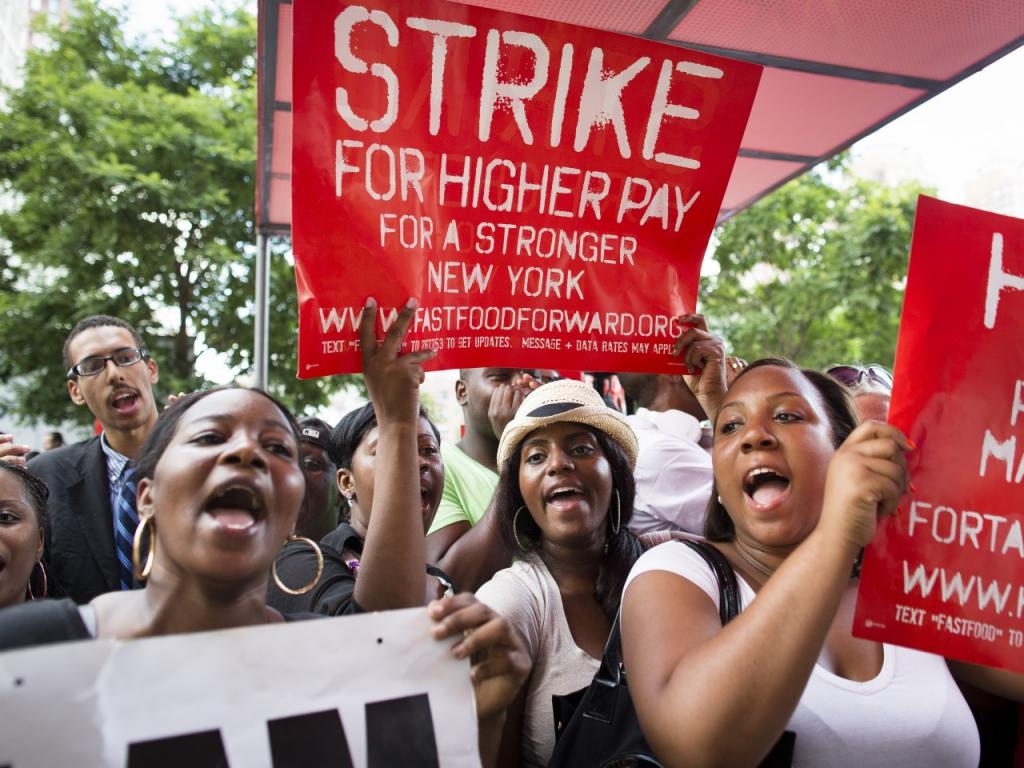
Some Big Victories for the Working Class and Poor
Ballot initiatives to increase the minimum wage passed statewide in Alaska, Arkansas, Nebraska and
South Dakota, and city wide in San Francisco and Oakland. Non-binding initiatives to increase the minimum wage passed in the state of Illinois and many Wisconsin counties.
On that same note, voters in Oregon and Washington DC chose to legalize marijuana, a blow to the decades long, racist drug war.
Friday, November 7, 2014
The Art of the Slogan: Socialism or Barbarism
Socialism or Barbarism, There Is No Third Way!Bourgeois society stands at the crossroads, either transition to Socialism or regression into Barbarism. -- Rosa Luxemburg, The Junius Pamphlet (The Crisis of German Social Democracy)
This slogan, as many great radical left slogans, comes from the turmoil of the early 20th Century (1915 is the first time we see a form of it in print which is quoted at the top of this post). With the rise of large proletarian populations in capitalist nations across Europe came the rise of revolutionary parties and the art of leftist sloganeering with them.
This slogan has proven legs, and at it has, at its heart, a very important meaning.
Ecosocialism or barbarism: There is no third way! -- Slogan of Climate & CapitalismWhy It Is Easy to Misunderstand
So isn't this just propaganda equating capitalists with barbarians and calling socialism the only viable alternative?
Not quite, although many radical leftists probably could sign on to such perspectives, but it means something much more interesting
Capitalism was still relatively young at this time, and already it had several recessions. Even capitalists had a hard time seeing how capitalism could last forever, and Karl Marx had laid down what still holds as the greatest criticism of a social system by defining contradictions within the capitalist idea which would inevitably lead to its end.
| 10,000 strong Communist rally in Union Square, New York, 08/01/1935 |
While social democratic reforms helped save capitalism for a time, it is still clear that no economic situation will last forever. The question, then, is what comes next?
The radical left made it very clear: capitalism will collapse for good one day, but what could replace it if not socialism? Barbarism. Primitive accumulation (think slavery, seizure, etc.) by the strong, fascism, relapse into feudalism (more of an issue in the world of 1915 when many countries were still feudal), etc.
Friday, October 24, 2014
Profile: David Graeber
The reason that economic textbooks now begin with imaginary villages is because it has been impossible to talk about real ones. Even some economists have been forced to admit that Smith's Land of Barter doesn't really exist.
The question is why the myth is perpetuated anyway. -- David Graeber, Debt: The First 5000 YearsPDF's of David Graeber
Video of David Graeber
Sunday, October 12, 2014
Solidarity Against Prejudice in the Working Class (Part 2)
Solidarity Is a Process
So each individual who is interested in liberation must find within themselves their attitudes which mirror the interest of the ruling class and eliminate these root and branch, finding the source and broken logic of the prejudice and replacing it with an attitude of liberation. This is a process. And you know it's a long one, requiring self-discipline and self-awareness and self-criticism. But, as with most things, the difficulty of the process only ennobles itself and people who take on its challenges.
When you live in a capitalist society, you can't help but internalize capitalist ideas. Every society acts that way. Every society must build its foundation of assumptions into the masses, or else it could not recreate itself with every generation, decade, year, month, or even day. Some of these assumptions are changed through popular struggle. Popular struggle can make a ruling class look so weak, so behind, that the ruling class must adapt to the change or fall to a revolution.The ideas of the ruling class are in every epoch the ruling ideas, i.e. the class which is the ruling material force of society, is at the same time its ruling intellectual force. The class which has the means of material production at its disposal, has control at the same time over the means of mental production, so that thereby, generally speaking, the ideas of those who lack the means of mental production are subject to it. -- Karl Marx, The German Ideology
So each individual who is interested in liberation must find within themselves their attitudes which mirror the interest of the ruling class and eliminate these root and branch, finding the source and broken logic of the prejudice and replacing it with an attitude of liberation. This is a process. And you know it's a long one, requiring self-discipline and self-awareness and self-criticism. But, as with most things, the difficulty of the process only ennobles itself and people who take on its challenges.
A Communist should have largeness of mind and he should be staunch and active, looking upon the interests of the revolution as his very life and subordinating his personal interests to those of the revolution; always and everywhere he should adhere to principle and wage a tireless struggle against all incorrect ideas and actions, so as to consolidate the collective life of the Party and strengthen the ties between the Party and the masses; he should be more concerned about the Party and the masses than about any individual, and more concerned about others than about himself. Only thus can he be considered a Communist.We are none of us so enlightened as to be free from this work. You and I and everyone who wants liberation must keep vigilant, making sure we pulled every weed of division from our gardens, and making sure no more spring up. There will be set backs and surprises as well as many victories as you come to feel more and more unity with the world's oppressed and a greater understanding of who you are and what you can become.
[...]
Communists must be ready at all times to stand up for the truth, because truth is in the interests of the people; Communists must be ready at all times to correct their mistakes, because mistakes are against the interests of the people. -- Mao Tse-Tung, Quotations from Chairman Mao Tse-Tung
Solidarity Against Prejudice in the Working Class (Part 1)
A Tale of Mistaken Identity
In my years living in the US South, I have met many working class people who more or less completely agree that their bosses are useless and yet get all the money, they know the government here isn't a democracy so much as the protectors of the rich, and they almost always agree it would be a good idea to start a new government where working people had a say. And yet, many times, after saying all of this, they will complain about Mexican immigrants.
I spoke to another worker recently who agreed to all those points above, but was very angry indeed about illegal immigrants from Mexico. "They come here and don't have to pay taxes and they can live on less than me, so they get the jobs. You can't tell me that doesn't hurt the average worker."
"But they are here in fear, facing brutal repression, just trying to feed their family, maybe find a better way of life. They have nothing. If the bosses who are paying immigrants too little and aren't hiring you at all were taken out of the picture, US workers and immigrants would have more than enough to share."
After our conversation, I realized that the whole problem was that this guy saw his differences with the illegal immigrants, not his similarities. Those differences (or race and nation and legal status) are all from the imagination of the rulers. Race is defined by the powerful (created and enforced by their laws which have created a racial caste system). Nations are made up by and for the rich. The legal statutes of the land are written up by the rich and their congressional lackeys.
As long as these fictional lines keep the oppressed from unifying against their common enemy (the bourgeoisie), we'll never be able to overpower them.
Solidarity: a Working Class Necessity
Solidarity (the unity of all workers, impoverished, and oppressed regardless of nation, race, sex, religion, or any other imaginary division) is the only way we can overthrow capitalism. Now more than ever, when the imperialist West controls the strongest military might in human history, when international corporations bully entire countries, when the IMF, WTO, and World Bank are more powerful than elected leaders, and when so much anti-imperialist resistance has been co-opted by religious extremists, the oppressed of the world must come together.
Some Material on Leftist Perspectives of ISIS
Meanwhile a major barrier to the spread of the ISIS plague to Lebanon is Hezbollah, a hated enemy of the US and its Israeli ally. And to complicate the situation further, the US and Iran now share a justified concern about the rise of the Islamic State, as do others in this highly conflicted region. -- Noam Chomsky, ISIS and Our TimesSo ISIS (the Islamic State of Iraq and Syria, also known as ISIL and IS) has been capturing headlines as it continues to wage its reactionary, islamo-fascist war. Now that radical left groups in the region are making great strides in fighting ISIS, and now that these groups might be getting help from NATO, another reactionary force that could eliminate the leftist groups as well, it seems a great time to understand the situation and figure out how we support the fight against both islamo-fascists and imperialists.
![]() |
| The radical left PKK anti-ISIS fighters. |
What Is Anarcho-Syndicalism?
They have taken untold millions that they never toiled to earnThe Union Makes Us Strong
But without our brain and muscle not a single wheel can turn
We can break their haughty power, gain our freedom when we learn that
The union makes us strong -- Solidarity Forever, lyrics by Ralph Chaplin
Anarcho-syndicalism calls for an anarchist revolution built around left-wing labor unions that will organize the economy through democracy after the overthrow of capitalism. "Syndicalism" by itself is a group of economic theories that advocate labor union organization of an economy, but "anarcho-syndicalism" specifically calls for the immediate overthrow of the state and the wage system.Historically, anarcho-syndicalism has been the most powerful of all anarchist traditions. It was central to the anarchist zones that flourished during the Spanish Revolution before being crushed by fascists (and Stalinists). Anarcho-syndicalism is the central ideology of the Industrial Workers of the World and was a popular strain in the U.S. during the Great Depression, helping popularize such heroes as Eugene V Debs and Emma Goldman. World-renowned linguist and political activist Noam Chomsky is a well-known anarcho-syndicalist.
Practically every building of any size had been seized by the workers and was draped with red flags or with the red and black flag of the Anarchists; every wall was scrawled with the hammer and sickle and with the initials of the revolutionary parties[...] Every shop and café had an inscription saying that it had been collectivized[...] Waiters and shop-walkers looked you in the face and treated you as an equal. Servile and even ceremonial forms of speech had temporarily disappeared. -- George Orwell, Homage to Catalonia
Anarcho-syndicalism uses labor unions to organize a revolution, building the revolutionary consciousness of the workers, bringing them together, and building solidarity with the workers of the world by unifying them to fight for their interests while capitalism still exists.
Once a revolutionary period occurs, the unions are ready to act. The strength of this idea showed itself in the Spanish Revolution. Because the anarcho-syndicalists had already been making decisions democratically and organizing the overthrow private property and the wage system, they were able to quickly overtake the economy and run it democratically. While the figures are hard to pin down, the local records suggest that productivity rose sharply under anarcho-syndicalism.
Anarcho-syndicalism believes that after the revolution, worker and general citizen unions become the decision making groups in society. These groups elect delegates (always able to be recalled) who help organize the society at large.
Wildcat Strikes: the Fight for Good Unions
So maybe you think unions are just corrupt, greedy clubs ran by mobsters, and maybe you think that isn't the best group to lead a revolution. Anarcho-syndicalists are not naive, they know that most unions are not capable or willing to lead revolutions, and that is what led to Wildcat strikes.
A "Wildcat strike" is a strike action by unionized workers who plan, organize, and lead the strike on their own, without the union bosses. This accomplishes several things all at once: it improves worker conditions when the strike succeeds, it puts power in the hands of the workers, it shows the uselessness of union bosses, and it makes for good practice in group decision making and solidarity.
Further Reading:
Subscribe to:
Posts (Atom)